


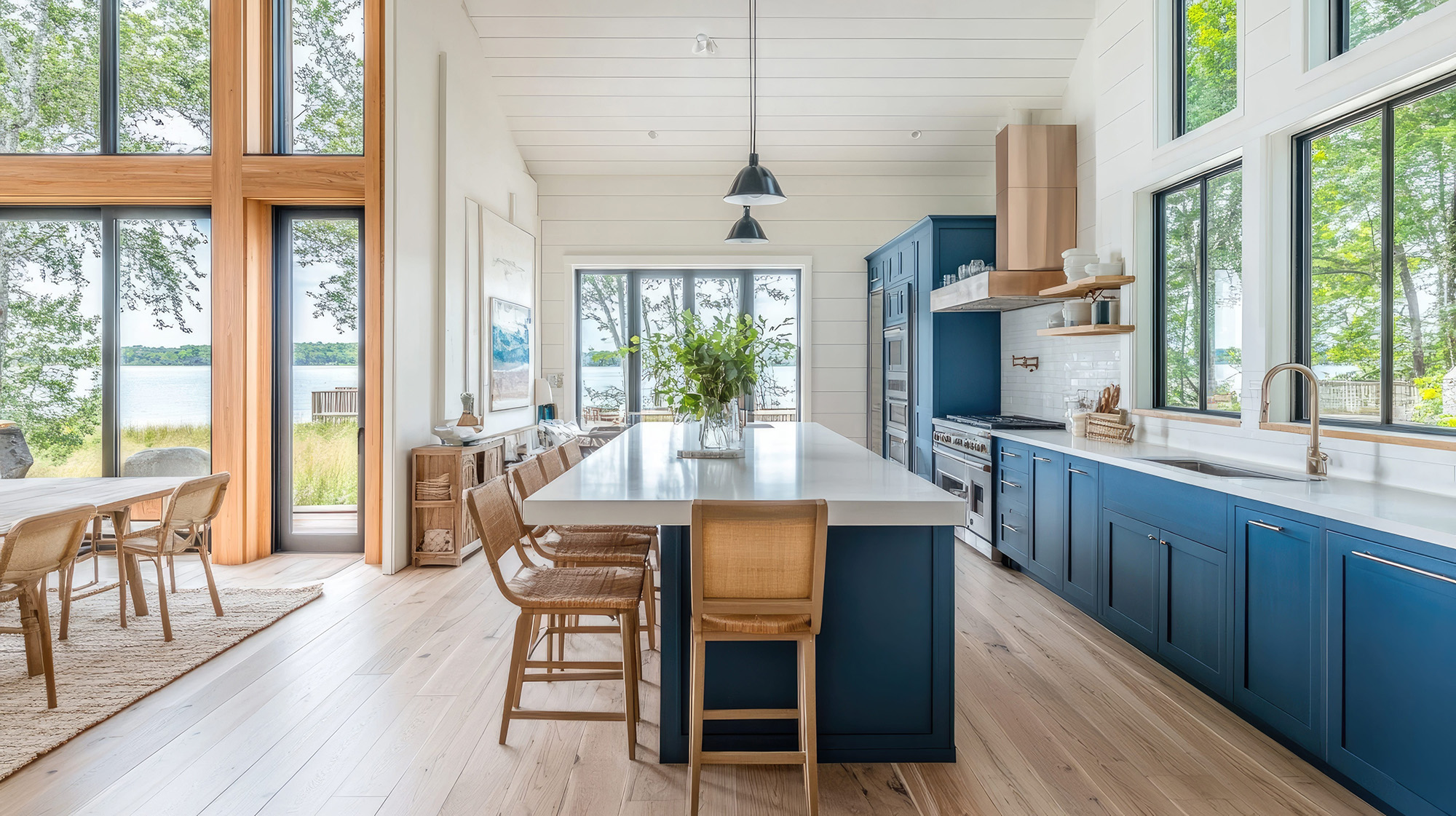
The open lanai is the whole reason people move to Southwest Florida, and it is also where more flooring projects quietly fall apart than anywhere else in the house. The transition point between conditioned interior and exposed exterior takes water, heat, UV, and tracked-in sand all at once. Choose the wrong material there and you get fading, cracked grout, or a slick spot waiting to cause a fall.
At Abbey Carpet & Floor at Patricia’s we plan that transition as carefully as the rooms themselves, because a beautiful interior floor is only as good as the threshold that connects it to the outside.
The Lanai Transition Is Where Most Florida Floors Fail
The problem starts with the assumption that one material can do everything. An interior luxury vinyl that performs perfectly in a climate-controlled living room is not built to sit in direct, uncovered sun, where surface heat and UV exposure push it past its design limits. Meanwhile a slick polished tile that looks stunning indoors becomes genuinely dangerous the moment it gets wet at the door.
The fix is to treat the threshold as its own design problem with its own spec requirements. That means matching slip resistance to a wet surface, matching thermal behavior to direct sun, and planning the seam between the two zones so it reads as intentional rather than as an afterthought where two unrelated floors collide.
Slip Rating and Heat Are Not Optional Specs
For any surface that gets wet, look at the dynamic coefficient of friction, written as DCOF. Under the ANSI A137.1 standard, a rating of 0.42 or higher is the benchmark for wet interior and transitional areas, and it is the number that keeps a rain-splashed threshold safe under bare feet. A textured or structured porcelain finish delivers this without looking industrial.
Heat is the second spec people forget. Dense porcelain and stone hold up to direct sun and stay dimensionally stable, while many resilient products are simply not rated for the surface temperatures an uncovered Florida patio reaches. If your lanai is covered and shaded, your options widen considerably. If it is open to the sky, porcelain pavers in a 2 centimeter thickness are the workhorse choice.
Where Vinyl Works and Where It Doesn't
Luxury vinyl absolutely belongs in this conversation, as long as you respect its limits. On a covered, shaded lanai it can carry the same wood look straight out from the interior, giving you that seamless flow people want. The key is keeping it out of standing water and direct, prolonged sun, and honoring the manufacturer's expansion gaps so heat has somewhere to go.
For uncovered transitions, the smart move is a matched look rather than a matched material. Many porcelain lines now offer a thinner interior format and a thicker outdoor paver in the same color and grain, so a wood-look vinyl or porcelain inside meets a porcelain paver outside and the eye reads one continuous floor. A proper transition profile at the door ties it together and protects every edge.
Indoor outdoor living is one of the best things about a home here, but it only works when the threshold is engineered for the job. Bring us your floor plan and a photo of your lanai, and we will spec the materials, slip ratings, and transitions that make the inside and outside feel like one space. We proudly serve Cape Coral, FL, Fort Myers, FL, Iona, FL, North Fort Myers, FL, Sanibel, FL, Bonita Springs, FL, Estero, FL, Naples, FL, Punta Gorda, FL, and Fort Myers Beach, FL.
Visit Cape Coral, FL to compare coordinated indoor and outdoor looks in person, or contact us today for a free in-home estimate built around how you actually live.


