


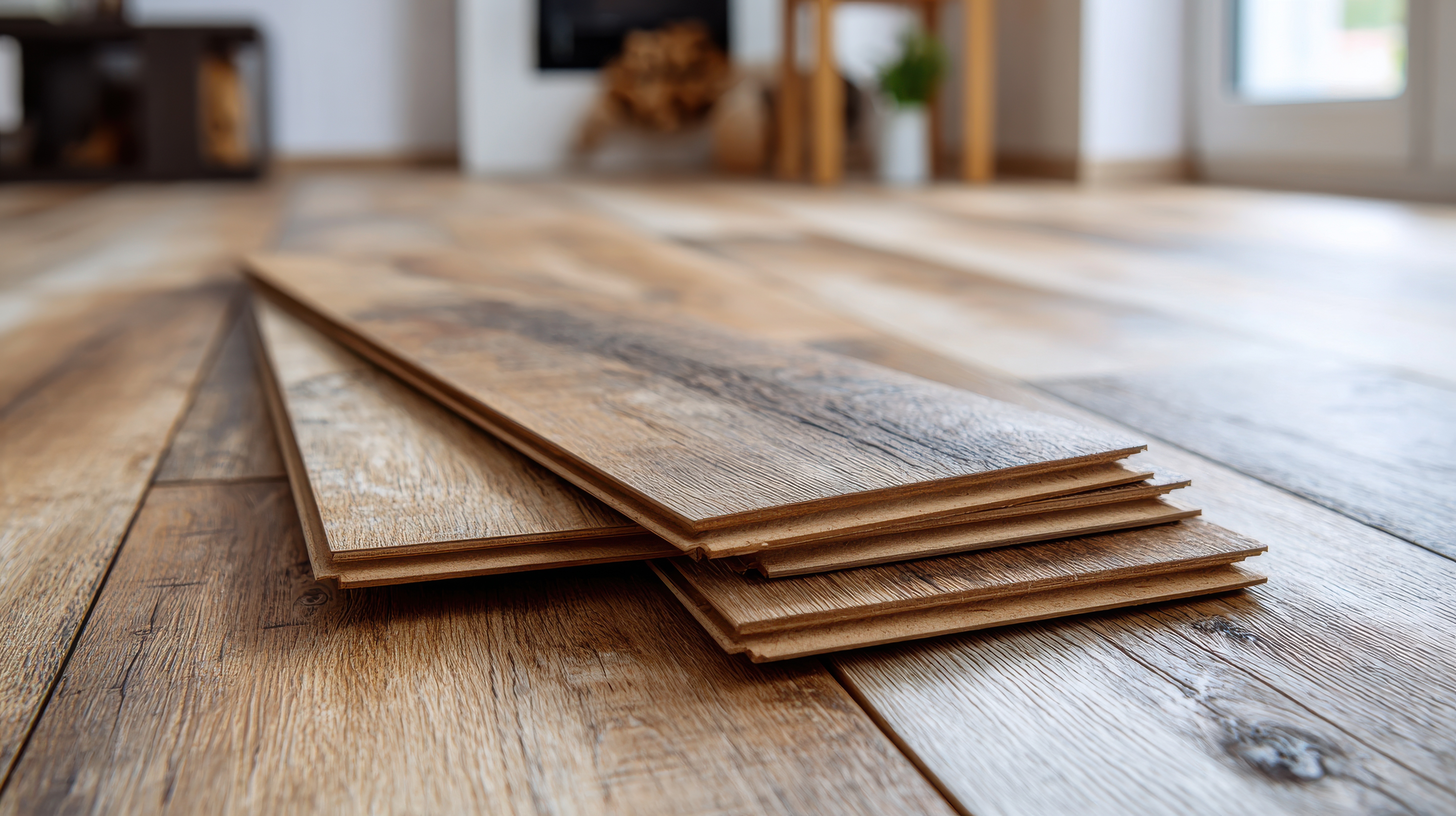
Walk into almost any new Southwest Florida home and you will see one thing repeated everywhere: wide, long planks running uninterrupted across a great room that flows into the kitchen and out toward the lanai. It is the defining look of the moment, and for good reason. But width is not just a style choice. It changes how the floor installs, how it moves with the seasons, and how forgiving it is of the slab underneath.
At Abbey Carpet & Floor at Patricia’s we help customers weigh that decision room by room, because the right width depends as much on your subfloor as on your taste.
Plank Width Changes How a Room Reads
Standard planks generally run around 5 inches wide, while wide planks land in the 7 to 9 inch range, and extra-long boards stretch up to 72 inches. In a large open floor plan, wider and longer boards mean fewer seams, and fewer seams make a big room feel calmer, cleaner, and more expansive. That is exactly why the look dominates open-concept Florida builds.
In a smaller or more broken-up space, the math can flip. Very wide planks in a compact room can feel heavy and can leave you with awkward narrow cuts at the walls. Standard widths give you more flexibility around tight transitions and doorways, and they often read as more traditional, which suits certain homes better than the sweeping modern look.
The Subfloor Truth Nobody Mentions
Here is the part that rarely makes it into the showroom pitch. The wider the plank, the more it reveals every imperfection in the surface beneath it. A long, rigid board bridges high and low spots instead of following them, so a slab that is even slightly out of flat can leave you with hollow spots, flex, or visible rocking at the seams.
Most manufacturers call for flatness within about 3/16 of an inch over a 10 foot span, and wide planks leave far less room for error against that tolerance. The practical result is that a wide-plank floor on a typical Florida slab often needs more prep, whether that is grinding high spots or skim-coating with a self-leveling compound. A rigid SPC core helps mask minor variation, but it is not a substitute for a flat substrate.
Width, Movement, and Humidity
In our humidity, movement matters. Solid hardwood in wide widths shows seasonal gapping more visibly than narrow boards, simply because each plank is moving across a greater dimension. Engineered hardwood, with its cross-layered construction, stays more stable and is the better wide-plank choice for this climate when you want real wood.
Luxury vinyl sidesteps most of the moisture-driven movement, which is one reason wide-plank LVP has taken over so quickly here. Even so, width does not cancel physics. Honor the expansion gaps at every wall and transition, give the planks their full acclimation time before installation, and you get the clean, seamless look without the callbacks that come from skipping those steps.
Wide or standard is not a question with one right answer. It is a balance between the look you want, the room you have, and the slab you are working with, and that is exactly the conversation our specialists love to have. We proudly serve Cape Coral, FL, Fort Myers, FL, Iona, FL, North Fort Myers, FL, Sanibel, FL, Bonita Springs, FL, Estero, FL, Naples, FL, Punta Gorda, FL, and Fort Myers Beach, FL, and we can assess your subfloor and floor plan before you commit to a width.
Come see wide and standard samples laid out together at Cape Coral, FL, or contact us today to schedule a free in-home measure and estimate.


